The best mobile hotspot devices of 2026, and the plans to pair them with
Six hotspots for T-Mobile, AT&T, Verizon, prepaid and travel abroad, what the data plans cost, and when your phone is enough.

Get the Franklin JEXtream RG3100 5G for most people: Wi-Fi 7, nearly 15 hours of battery, and $99.99 at Metro. On AT&T or Verizon, get the Inseego MiFi Pro M4. For travel abroad, the unlocked Netgear Nighthawk M7 or a cloud-SIM hotspot. If you only tether a few hours a week, your phone's hotspot is enough.
Some links on this page are affiliate links: We may earn a commission if you sign up or buy, at no cost to you. It never affects our rankings. For more information, see our Advertiser disclosure. Metro, Straight Talk, US Mobile, GlocalMe and Amazon may pay us a commission.
Updated Oct 18, 2026: new top pick (Franklin JEXtream RG3100 5G), Inseego MiFi Pro M4 added for AT&T and Verizon, and carrier data plan prices rechecked.
Black Friday 2026: Amazon, Best Buy and Walmart hadn't announced their Black Friday sale dates as of Oct 29. Black Friday is Nov 27, and Amazon's sale opened Nov 20 last year. Until sale prices go live, see our backup internet and power deals.
Quick picks
Prices checked Oct 18, 2026 at carrier and retailer sites. Carrier prices often assume a new line or installment plan.
The picks
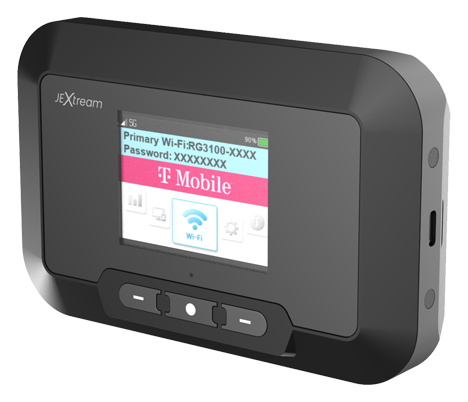
Franklin JEXtream RG3100 5G
Wirecutter's top pick after its September 2026 retest. The RG3100 lasted 14 hours 44 minutes in its tethered battery test, about 50% longer than the runner-up, and kept pace with a 5G phone's own hotspot speeds. A QR code on the screen lets phones join without typing a password, and the battery can charge your phone.
The screen isn't a touchscreen, and Wirecutter found the Ethernet port only worked with the hotspot plugged in. T-Mobile coverage thins out in rural areas.
It is $199.99 at T-Mobile, which requires at least one month of a hotspot plan, or $99.99 at Metro by T-Mobile with a prepaid plan.
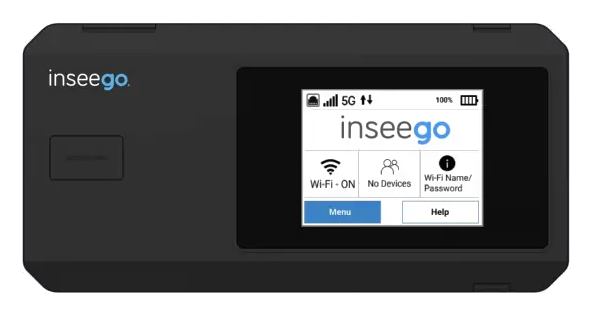
Inseego MiFi Pro M4
The same hotspot is sold as the M4040 at AT&T ($209.99) and the M4330 at Verizon ($299.99). It connects up to 50 devices, and switching to Ethernet only stretches the battery a long way: Wirecutter measured 16 hours 22 minutes on AT&T and 23 hours 20 minutes on Verizon that way, versus 9 to 12 hours on Wi-Fi.
Check the Inseego M4 on Amazon.
It takes about a minute and a half to boot and connect. AT&T has offered it free with an eligible unlimited plan through 36 months of credits.
Netgear Nighthawk M7
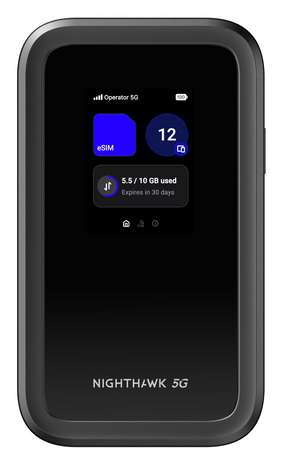
PCMag's best unlocked hotspot, and one of the few good unlocked models with international bands sold in the US. It takes a physical SIM or a third-party eSIM, and Netgear's app sells eSIM data when you land. It works on AT&T and T-Mobile; PCMag notes no official Verizon support yet.
At $499.99 it is the most expensive pick. The battery is not removable and there is no mmWave 5G.
Netgear Nighthawk M7 Pro
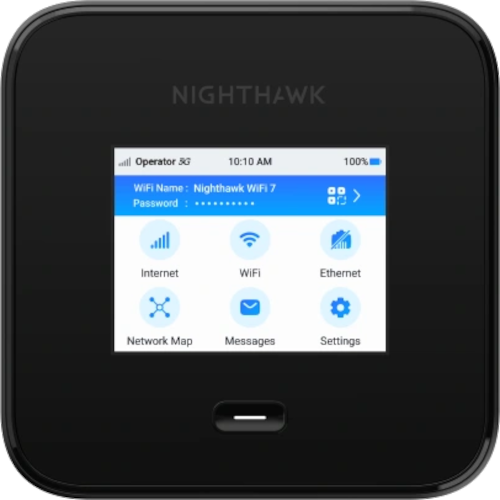
Twice the device limit of most hotspots and a 2.5 Gbps Ethernet port, which suits a job site, pop-up office or RV with a router behind it. PCMag measured 11 hours 53 minutes of battery and named it the best AT&T hotspot.
It costs $449.99, is tied to AT&T, can't charge other devices, and the 6 GHz band only works while plugged in.
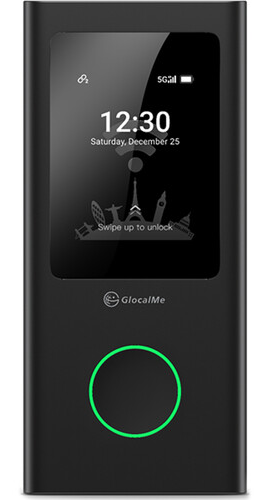
GlocalMe Numen Air
A cloud-SIM hotspot connects to a local network in each country without a SIM card. You buy data passes in the GlocalMe app by the trip, and you can drop in a local SIM when that is cheaper. List price is $329.99; GlocalMe has sold it for $287.99 with 15 GB of global data included.
Its Wi-Fi is the older Wi-Fi 5 standard, and data passes add up if you travel often. GlocalMe's MeowGo G50 Max ($529.99) adds satellite messaging and 1 GB of data a month for life.
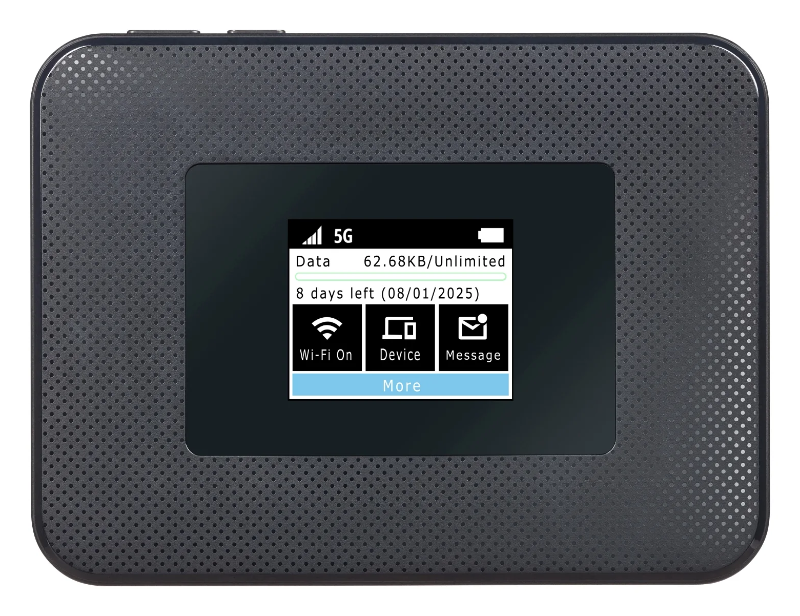
BLU M100 5G
About $50 at Walmart and Best Buy, locked to Verizon-network prepaid brands. Pair it with Straight Talk's hotspot data: 10 GB for $25 or 100 GB for $50, each good for 30 days. It is a fair choice for a vacation home or a few trips a year.
Expect older Wi-Fi and a shorter battery than the picks above.
Hotspot data plans compared
The device is a one-time cost; the plan is what you pay every month. These are hotspot-only plans from the three big carriers and the cheapest prepaid options.
Carrier prices from Wirecutter, Aug 19 and Sep 10, 2026. Confirm at the carrier before you order.
On Verizon, add the hotspot as a line on your phone account instead of buying a standalone plan. The 150 GB plan drops from $110 to $60–$80 a month with a recent unlimited phone plan. AT&T's $26 add-on only includes 15 GB, so a standalone AT&T plan is usually the better deal.
Budget about 3 GB for each full day of laptop work, per Wirecutter, and 2 to 5 GB for a day of video calls. A remote worker on the hotspot every weekday will use 60 to 100 GB a month.
For an AT&T hotspot such as the Inseego MiFi Pro M4, Cricket's 100 GB plan is the cheapest way onto AT&T's network: $55 a month with taxes included, or 200 GB for the same price if you have a Cricket phone line. Extra data is $10 per 5 GB, and the plans work in Mexico and Canada. Cricket charges a $25 activation fee in stores, not online.
More on the prepaid plans above: Straight Talk, Ultra Mobile and Visible, Mint and US Mobile.
Hotspot or your phone?
Most people should try their phone first. Phone plans have grown more generous: AT&T's unlimited plans include 3 GB to 250 GB of hotspot data, T-Mobile's 60 GB to 250 GB, and Verizon's 30 GB to 200 GB. Prepaid plans like US Mobile Unlimited Premium include 50 GB or more for $44 (see our US Mobile review).
A dedicated hotspot is worth it when you tether every workday, connect more than two or three devices, or need your phone free and charged for calls. It also gives you a second network: if your phone is on Verizon, a T-Mobile hotspot covers places Verizon doesn't.
Turn off Wi-Fi on the hotspot and plug your laptop in with Ethernet or USB-C. In Wirecutter's tests, the Verizon MiFi Pro M4 went from 11 hours 38 minutes to 23 hours 20 minutes that way.
Traveling abroad? A travel eSIM on your phone is often cheaper than a hotspot plan.
Best hotspot for each situation
- No contract: the RG3100 at Metro, the BLU M100 with Straight Talk, or any cloud-SIM hotspot. More options are in our prepaid Wi-Fi guide.
- Unlimited data: no hotspot plan is unlimited at full speed. The closest options are Verizon's 150 GB plan, Visible's speed-capped unlimited hotspot and US Mobile Premium on Dark Star (100 GB full speed, then 100 GB at 8 Mbps).
- International travel: the unlocked Nighthawk M7 with a local eSIM, or the GlocalMe Numen Air if you cross borders often. See how eSIMs work and Wi-Fi on a plane.
- RVs and road trips: a hotspot with Ethernet feeding a travel router, or T-Mobile AWAY and Starlink. Compare them in the best RV internet.
- Gaming: fine for casual play and downloads. Plug in with Ethernet or USB-C, and read whether 5G is good for gaming before relying on it for competitive play.
- Backup for home internet: a prepaid hotspot you top up only during outages. See the best backup internet and backup internet for remote workers.
Can a hotspot replace home internet?
For one person who mostly browses and emails, sometimes. For a household that streams, no. Xfinity reported in 2025 that its customers use about 500 GB a month, several times what any hotspot plan includes. If cable and fiber don't reach you, check 5G home internet first: it uses the same cell networks with unlimited data for a flat price. Beyond the cell network, Starlink or a local wireless provider is the usual answer.
What to check before you buy
- Carrier lock: carrier-sold hotspots are usually locked. Buy unlocked if you might switch networks.
- 5G bands: look for n41 (T-Mobile) or n77 (AT&T and Verizon C-band). These mid-band frequencies carry most fast 5G.
- Battery: rated hours assume light use. Look for at least 8 hours, and a model that can run on wall power for home use.
- Ethernet and USB-C: a wired connection avoids Wi-Fi congestion in hotels and often stretches battery life.
- Antenna ports: TS9 ports let you add an inexpensive external antenna for weak rural signals. mmWave models usually skip them.
New hotspot models may arrive slowly. In April 2026 the FCC confirmed that its ban on approving new foreign-made Wi-Fi routers also covers hotspots, unless the maker has conditional approval.
More ways to stay connected away from home are in internet on the go. Hotspot discounts usually show up during Black Friday week.
How we picked
We compared current carrier and retailer listings, maker spec sheets, and published hands-on testing from Wirecutter and PCMag, then ranked on what matters most for a hotspot:
- Network and 5G bands: support for mid-band 5G (n41, n77) on the carrier it is sold for.
- Measured battery life: at least 8 hours in independent tests, not just the rated figure.
- Plan cost: what the data costs per month on the carrier it is locked to.
- Connections: Wi-Fi 6 or 7, USB-C charging, and Ethernet for wired use.
More on our process is in how we research.
Others we considered
- Inseego MiFi X Pro 5G: A long-time favorite at about $250, but it uses Wi-Fi 6 and has been replaced by the MiFi Pro M4 at most carriers.
- Orbic Speed 5G UW (Verizon): PCMag's Verizon pick at $299.99. It works with Verizon's newest 5G but is big, heavy, and drains fast on the fastest 5G.
- Franklin JEXtream RG2100 (T-Mobile): PCMag's T-Mobile pick and often under $140 at Amazon, but it is a 2022 model with Wi-Fi 6 and no Ethernet port.
- TCL Linkzone 5G UW (Verizon): Has Ethernet and parental controls, but Wirecutter measured slow downloads and only 7 hours 35 minutes of battery.
- Sonim MegaConnect (AT&T): Rugged and supports FirstNet for first responders, but costs more and only has Wi-Fi 6.
- SIMO Solis Hero: A $179.99 cloud-SIM puck with an 18-hour battery claim, but 4G only.
Questions
What is the best mobile hotspot device?
The Franklin JEXtream RG3100 5G for most people. It has Wi-Fi 7, connects up to 32 devices, and lasted 14 hours 44 minutes in Wirecutter's battery test. It sells for $199.99 at T-Mobile and $99.99 at Metro. On AT&T or Verizon, get the Inseego MiFi Pro M4.
What is the best mobile hotspot with no contract?
Any prepaid hotspot. The cheapest are the Franklin RG3100 at Metro ($99.99 with a prepaid plan) and the BLU M100 5G at Straight Talk or Simple Mobile (about $50). For travel abroad, cloud-SIM hotspots like the GlocalMe Numen Air have no plan at all; you buy data passes when you need them.
Is there a mobile hotspot with truly unlimited data?
Not at full speed. Hotspot-only plans top out at 150 GB a month (Verizon). Visible sells unlimited hotspot data capped at 5 to 15 Mbps. US Mobile's Unlimited Premium on its AT&T network includes 100 GB at full speed and 100 GB more at 8 Mbps. If you need unlimited data at home, 5G home internet is the better fit.
Is a hotspot better than using my phone?
For a few hours a week, your phone is enough. Phone plans now include 30 GB to 250 GB of hotspot data. A dedicated hotspot is worth it if you tether every workday, share a connection with several people, or don't want to drain your phone battery.
Can a mobile hotspot replace home internet?
Only for light use. Hotspot data costs far more per gigabyte than home internet, and the average US home uses close to 500 GB a month. For a rural property, check 5G home internet, Starlink or a local wireless provider first.
Is a mobile hotspot good for gaming?
It works for casual games and downloads. Competitive online games may see higher and less steady ping than on cable or fiber, and busy towers in the evening make it worse. Use the hotspot's Ethernet port or USB-C tethering instead of Wi-Fi to cut lag.
- Wirecutter, "The Best Wi-Fi Hotspot," updated Sep 16, 2026 (battery tests and carrier data plans)
- PCMag, "The Best Mobile Hotspots for 2026," updated Jul 28, 2026
- Carrier and retailer listings: T-Mobile, Metro by T-Mobile, AT&T, Verizon, Straight Talk, GlocalMe, Netgear, checked Oct 18, 2026
- Freaking Nomads, "Best Mobile Hotspots for Remote Work," Sep 23, 2026; HighSpeedInternet.com, "The Best Mobile Hotspots of 2026"
Our picks are based on specs, carrier pricing and published lab tests, noted where used.
Prices and offers change often; confirm at your address before you order. How we research
Jean founded ShopHighSpeed after trying to find one straight answer about business internet in his own town. He has been a Comcast and Verizon Fios customer, and ranks providers on what they actually deliver, not on what they advertise.